

What functions can a robotic arm with sensors achieve?
Solve the problem
·It can realize real-time correction of weld deviation, intelligent real-time tracking, and guide the welding gun to weld automatically;
·It can effectively solve the problems caused by thermal deformation during welding and ensure the beautiful shape of the weld;
·It can put the welding gun in an ideal position, greatly improve production efficiency and welding quality, and ensure welding safety.
Function Introduction
01 Hand-eye Calibration
Determine the coordinate transformation relationship between the sensor coordinate system and the spatial manipulator coordinate system.
Transform the sensor coordinate system into the manipulator's spatial coordinate system to control the manipulator to reach the specified position.
For some applications, Chuangxiang provides a unique calibration method that is easier to operate.
02 Real-time tracking
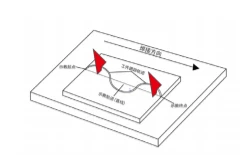
Function description: Real-time detection and storage of weld position, real-time correction.
Applicable scenarios: material feeding deviation, welding thermal deformation, complex curved welds.
Typical cases: box welding, thin plate welding, saddle line welding, fan blades, etc.
Extended functions: start end detection, welding self-adaptation.
03 Single point positioning
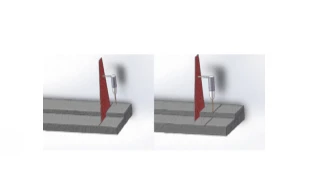
Function description: Find the absolute position of a point.
Applicable scenarios: Solve the left and right and height deviation of the weld.
Typical case: spot welding.
04+Two-point positioning
Function description: Find two points to determine a straight line.
Applicable scenarios: straight welds, clamping translation and rotation deviations.
Typical cases: intermittent welding, straight welds.
Extended functions: Expanded to multi-point positioning to fit straight lines or curves, straight lines to find two points, and automatically allocate intermittent welds.
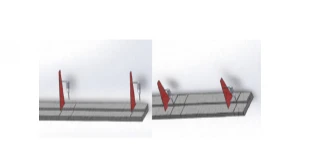
05 Coordinate system positioning
Function description: Calculate the workpiece coordinate system through three or four points.
Applicable scenarios: Standard parts have grouping and clamping deviations.
Typical case: Continuous welding of special-shaped angle workpieces.
Extended function: All intersection points can be calculated to replace the teaching points.
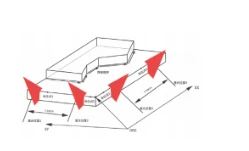
06 Adaptive welding
Function description: Real-time detection of weld width, adjustment of swing amplitude, current, voltage and welding speed.
Applicable scenarios: Large gap deviation of weld group.
Typical case: Butt joint of medium and thick plate groove.
Extended function: Control welding speed, swing amplitude, current and voltage.
07 Multi-layer and multi-pass tracking welding
Function description: Track and save the trajectory, and replay and implement multi-layer and multi-pass.
Applicable scenarios: Medium and thick plate welding.
Typical cases: Engineering machinery, coal mining machinery, mining machinery.
Extended function: Adaptive multi-layer and multi-pass welding.
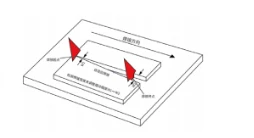
Composition principle
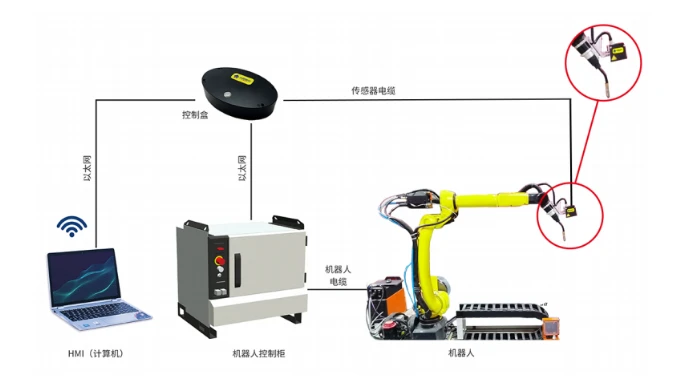
It adopts intelligent real-time weld tracking technology and non-contact tracking method, measures weld deviation through sensors, guides and controls welding gun positioning, avoids welding defects caused by workpiece position deviation, thermal deformation, etc., and improves production efficiency and product quality.
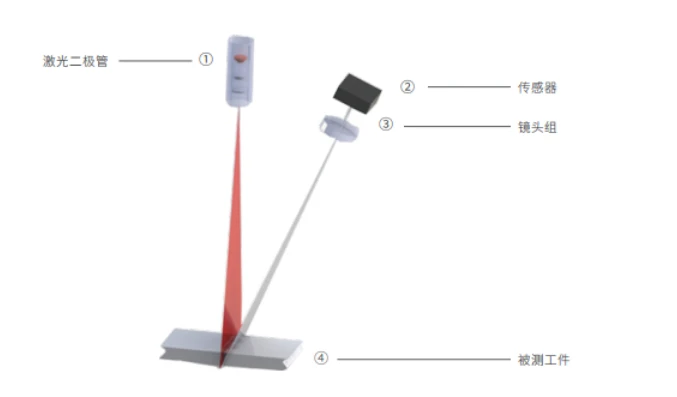
Solve the problem
It can realize real-time correction of weld deviation, intelligent real-time tracking, and guide the welding gun to weld automatically;
It can effectively solve the problems caused by thermal deformation during welding and ensure the beautiful shape of the weld.
Scope of application
It can communicate with PLC, text screen, industrial computer and other equipment of various brands to achieve connection and automatic control;
It is suitable for various welding machines such as straight seam special machine, circular seam special machine, welding trolley, gantry, cross special machine, etc.
Weld Types
Supports various weld types including V-groove welds, fillet welds, rolled welds, spliced welds, lap welds, etc.
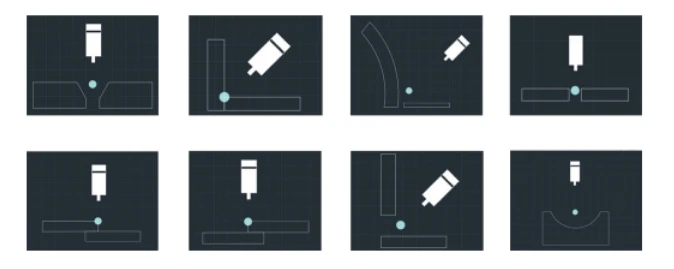
Robotic weld tracking and positioning system
Detect the position of multiple points on the weld and quickly correct the position deviation of one or more welds through algorithm processing.
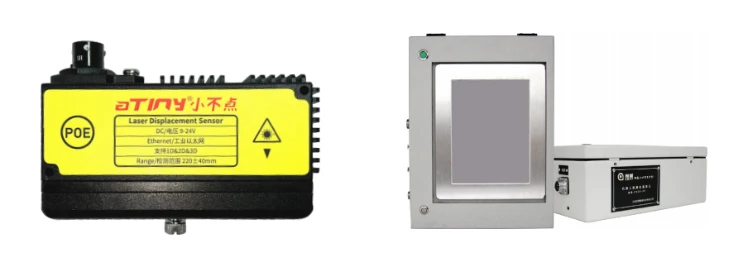
·The small laser displacement sensor solves the interference problem with its "small size";
·Achieve fast two-point, three-point, and multi-point positioning of straight and curved welds;
·Widely used in automated welding of steel structures, small parts, car body panels, new energy battery boxes and other industries.