

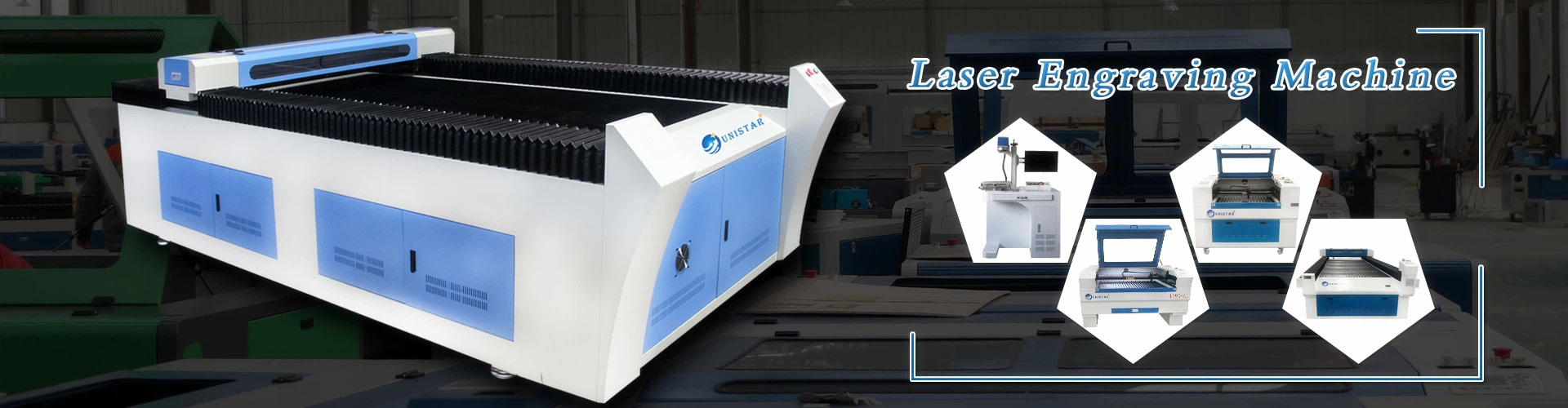
Laser Marking Machine
Fiber Marking Machine, CO2 Laser Marking Machine
What is Laser Marking Machine
Laser Marking Machine engraves the letters onto object or process an object by using the heat of laser beam. It is easy to fade away if printed by ink, or printed labels ended up by coming off. However, Laser Marking Machine can mark to an object including non-flat surfaces and will remain permanent.The laser marking technology creates lasting marks on component surfaces by generating focused beams of light containing high energy levels. The built-up energy is released in the coherent light beam directed at the material surface using mirrors. As a result of the light beam interacting with the component’s surface, there is a transfer of heat energy from the beam to the surface. Therefore, the appearance and properties of the material will change. Depending on the energy level, the laser can engrave, etch, anneal, or discolor surfaces with great precision.
Advantages of Laser Marking Machine
Permanent marks
Laser marking machines mark permanently. The marks cannot be rubbed off or fade away through time or exposure to contaminants.
Fast marking
Laser marking can be a quicker and more efficient marking process than chemical etching and inkjet printing. Chemical etching requires many steps that can last days, and laser marking happens instantaneously. Inkjet printing/labeling has consumables and replacement parts that can slow down the process and often lead to downtime—laser marking technology does not.
Versatile use
Purchasing laser marking technology is an addition to your toolbox beyond just a basic marking system. Laser marking machines are effective on a range of materials, sizes, industries, and processing methods.
Precision and accuracy
Laser marking offers unparalleled precision and accuracy in marking various surfaces. The laser beam is extremely fine and can create very small, intricate designs and markings that would be impossible to achieve with other methods. This makes it ideal for marking small parts, including those with complex geometries.
-
![50W Fiber Laser Deep Engraving Machine For Metal]() 50W Fiber Laser Deep Engraving Machine For MetalLaser deep engraving machine with 50 watt fiber laser source is the best etcher for 3D metal relief engraving on crafts, guns, parts, tools, molds, coins made of stainless steel, titanium,...read more
50W Fiber Laser Deep Engraving Machine For MetalLaser deep engraving machine with 50 watt fiber laser source is the best etcher for 3D metal relief engraving on crafts, guns, parts, tools, molds, coins made of stainless steel, titanium,...read more -
![Online Flying Fiber Laser Marking System For Parts & Tools]() Online Flying Fiber Laser Marking System For Parts & Tools20W online flying Raycus fiber laser marking system is used for marking on the fly (MOTF) in industrial mass production and assembly line production with metal parts, tools, tags, signs, wire,...read more
Online Flying Fiber Laser Marking System For Parts & Tools20W online flying Raycus fiber laser marking system is used for marking on the fly (MOTF) in industrial mass production and assembly line production with metal parts, tools, tags, signs, wire,...read more -
![2025 Best Pen Laser Engraving Machine For Sale]() 2025 Best Pen Laser Engraving Machine For SaleA laser pen engraving machine is a type of laser marking system with CNC (Computer Numerical Control) that adopts a laser beam to leave permanent marks on letters, numbers, signs, logos, patterns,...read more
2025 Best Pen Laser Engraving Machine For SaleA laser pen engraving machine is a type of laser marking system with CNC (Computer Numerical Control) that adopts a laser beam to leave permanent marks on letters, numbers, signs, logos, patterns,...read more -
![High Cost Performance 5W UV Laser Marking Machine]() High Cost Performance 5W UV Laser Marking MachineUV Laser Marking Machine Price for Metal, Steel, Iron, Aluminum, PVC, Engraving Laser marking machine is a kind of precision processing equipment that uses high-energy laser beam to make...read more
High Cost Performance 5W UV Laser Marking MachineUV Laser Marking Machine Price for Metal, Steel, Iron, Aluminum, PVC, Engraving Laser marking machine is a kind of precision processing equipment that uses high-energy laser beam to make...read more -
![Good Quality Laser Marking Machine]() Good Quality Laser Marking MachineLaser marking machine is a marking equipment using laser technology.read more
Good Quality Laser Marking MachineLaser marking machine is a marking equipment using laser technology.read more
The working principle is to use a laser beam to mark or mark the object, and by changing the power density of the laser... -
![Fiber Laser Marking Machines]() Fiber Laser Marking MachinesSuitable for metal, plastic, rubber, ceramic and other materials, widely used in industrial manufacturing, food packaging, medical equipment, jewelry, toys and crafts and other fields. In the...read more
Fiber Laser Marking MachinesSuitable for metal, plastic, rubber, ceramic and other materials, widely used in industrial manufacturing, food packaging, medical equipment, jewelry, toys and crafts and other fields. In the...read more -
![China High Quality Fiber Laser Marking Machine For Metal And Nonmetal, Hard PVC, Keyboard, Cellphone Shell With Raycus 20W, 30W, 50W, 70W Fiber Laser Marker]() China High Quality Fiber Laser Marking Machine For Metal ...Fiber Laser Marking Machine is suitable for metal engraving , For example , Stainless Steel Sheet, Mild Steel Plate, Carbon Steel Sheet, Alloy Steel Plate, Spring Steel Sheet, Iron Plate,...read more
China High Quality Fiber Laser Marking Machine For Metal ...Fiber Laser Marking Machine is suitable for metal engraving , For example , Stainless Steel Sheet, Mild Steel Plate, Carbon Steel Sheet, Alloy Steel Plate, Spring Steel Sheet, Iron Plate,...read more -
![UV Marking Machine]() UV Marking MachineUv laser marking machine belongs to the series of products of laser marking machine, but it uses 355nm ultraviolet laser research and development, the machine uses three-stage cavity frequency...read more
UV Marking MachineUv laser marking machine belongs to the series of products of laser marking machine, but it uses 355nm ultraviolet laser research and development, the machine uses three-stage cavity frequency...read more -
![Small Size Metal Marking Machine]() Small Size Metal Marking MachineFiber laser marking machine is a kind of high precision and high stability marking equipment.read more
Small Size Metal Marking MachineFiber laser marking machine is a kind of high precision and high stability marking equipment.read more
Fiber laser marking machine is widely used in all walks of life, especially in electronics,... -
![Good Quality Cheap Laser Marking Machine]() Good Quality Cheap Laser Marking MachineLaser marking machine is a marking equipment using laser technology.read more
Good Quality Cheap Laser Marking MachineLaser marking machine is a marking equipment using laser technology.read more
The working principle is to use a laser beam to mark or mark the object, and by changing the power density of the laser... -
![CNC Fiber Laser Marking Machine]() CNC Fiber Laser Marking MachineFiber laser marking machine is a laser with rare earth element doped glass fiber as the gain medium, fiber laser marking machine has become a hot laser physics research in recent years, it is...read more
CNC Fiber Laser Marking MachineFiber laser marking machine is a laser with rare earth element doped glass fiber as the gain medium, fiber laser marking machine has become a hot laser physics research in recent years, it is...read more -
![Fiber Laser Marking Machine 20W With Raycus Laser Source/Laser Engraver With Full Enclosed Cover]() Fiber Laser Marking Machine 20W With Raycus Laser Source/...The fiber laser marking machine is mainly used to mark on the metal materials and parts non-metal meaterials,such as the stainless,carbon,alread more
Fiber Laser Marking Machine 20W With Raycus Laser Source/...The fiber laser marking machine is mainly used to mark on the metal materials and parts non-metal meaterials,such as the stainless,carbon,alread more


Why Choose Us
Rich Experience
UNISTRCNC boasts professional technical and research teams with extensive experience in CNC routers, ATC CNC routers, laser machines, laser cutting machines, laser marking machines, CNC metal engraving machines, CNC plasma cutting machines, and fiber metal cutting machines.
Professional Team
Shandong Unistar Machinery Co.,Ltd specializes in manufacturing and exporting CNC machines and laser machines since 2002. The company operates two large factories, one dedicated to CNC routers and the other to laser machines.
Certificate of Qualification
All our products have obtained CE, FDA, and SASO certificates, ensuring quality assurance.
Problem Solving
Our technical engineers solve customer problems promptly, ensuring customer satisfaction and worry-free machine usage.
How Does Laser Marking Machine Work
Step 1: Generation of the Laser Beam
The generation of the laser beam in any laser marking equipment depends on three important components:
The lasing medium is responsible for the wave position and the excitation energy required by the machine. Common lasing mediums include neodymium-doped yttrium aluminum garnet (solid) and organic dyes (liquid), and CO2 (gas). The lasing medium can also be a geometric shape, such as the fiber lasers.
The pump source is responsible for introducing energy to the laser marking machine, which excites the lasing medium and leads to photons’ emission through spontaneous or stimulated emission.
The optical resonator has a reflective (high reflector) and partially reflective (output coupler) mirror. It functions in reflecting the light produced by the lasing medium. It can also contain other things, such as a modulator and q-switch, that can change the generated laser beam properties.
Energy becomes introduced into the lasing medium. This leads to the excitation of the lasing medium atoms and the emission of photons. The light enters the optical resonator and undergoes total internal reflection to create the laser beam. The laser can then be passed to components such as the q-switch, lenses, beam expanders, etc., to shape the beam before releasing it.
Step 2: Marking
When the laser beam touches the workpiece’s surface, the heat energy produced causes a change in the features and attributes of the material. The types of change depend on the laser technology you choose. A permanent mark is then left on the surface of the workpiece.
Common Types of Laser Marking Machine Techniques
There are several laser marking systems applicable in part manufacturing processes. Each has its mechanism for using the laser. For example, laser engraving removes parts of a material. Hence, it is applicable in logo or character processing. The three most common laser marking types include:
Laser engraving is the most common marking method in part manufacturing and prototyping, suitable for working on materials like metals, ceramics, and plastics. Like any laser marking method, it delivers permanent marking, although it has less clarity than others on the list.
Laser engraving is a subtractive process, i.e., it involves using the laser beam to remove part of the material surface. The laser beam focusing on the surface turns the removed material into plasma or vapor removed by the fume extractor. On removal, it leaves an engraved marking that is easily felt by the fingers.
Laser etching is another marking method for making permanent marks on a workpiece. It commonly applies to metals such as etching aluminum, steel, stainless steel, lead, etc. The laser marking machine etches the workpiece by releasing pulsed laser beams on the workpiece surface. On hitting the surface, the material absorbs the beam and converts it to heat to melt the surface and raises it.
The laser-etched surface requires less energy as it does not have depth, unlike laser engraving. Furthermore, they are more visible. For example, laser-etched aluminum will be more visible than laser-engraved aluminum.
Laser annealing is a non-subtractive process commonly used for products with important dimensional accuracy. It involves using laser beams to slowly heat and cool metal surfaces to modify their color (yellow, red, or green) depending on the temperature of the metal’s surface.
The laser annealing process is not suitable for non-ferrous metals and aluminum because their colors are not affected by the influence of heat and oxide.
Types of Lasers Marking Machines

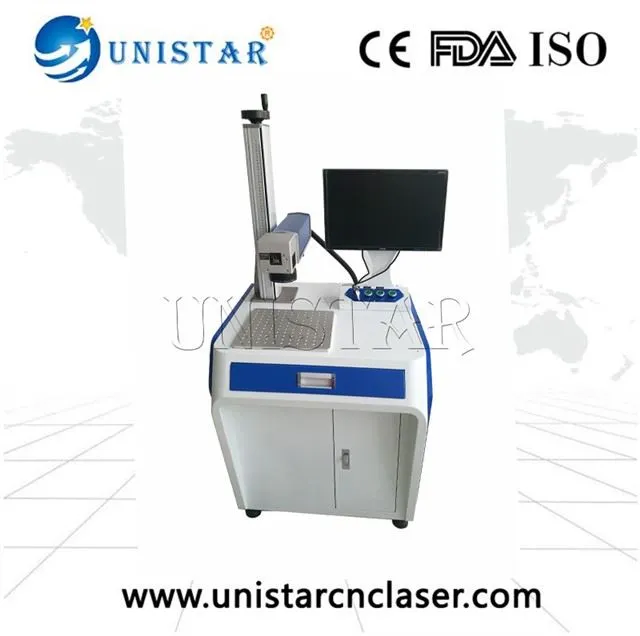


CO₂laser markers
CO₂laser markers use CO₂as the lasing medium and the most suitable marking system for organic materials (they are also suitable for metals after treating the metal with a special marking agent, which gives it a permanent, high contrast mark).
They have the longest wavelength (10600nm) of all laser marking systems, which makes them useful in marking different materials as required by different industries. Furthermore, they also provide faster marking speeds when working with thick materials, especially in sheet metal laser cutting.
Fiber laser markers
Fiber laser markers are a newer, simpler, and more versatile marking system that uses high-tech fiber optics as a lasing medium. They are suitable for marking non-organic materials like metal, steel, aluminum, etc.The fiber laser marking system has high marking speeds and consumes less energy. Furthermore, they require low maintenance. However, they are unsuitable for marking thick materials.
Green laser markers
Green laser markers have a high wavelength (532nm). They are suitable for marking highly reflective and sensitive materials like PCB boards, soft plastics, etc. In addition, they create highly precise markings on workpieces and can absorb different types of materials.
MOPA laser markers
Master Oscillator Power Amplifier (MOPA) lasers are applicable in creating black markings on high-quality metals and plastics. They use a master oscillator to generate the beam, and the power amplifier increases the output power level.
Applications of Laser Marking Machine
Automotive industry
Laser marking is widely used in the automotive industry for various purposes. It is commonly employed for part identification, allowing easy tracking and identification of components. Traceability codes and serial numbers are laser marked on engine parts to ensure accurate documentation and quality control.
01
Electronics industry
Laser marking is a vital process in the electronics industry for marking metal components with identification codes, logos, and other essential information. This technique enhances brand recognition and ensures product authenticity, making it a valuable branding tool.
02
Medical industry
Laser marking is widely used in the medical industry to mark medical devices with important information. It creates precise surface markings on metal, such as lot numbers, manufacturing dates, and regulatory symbols. These identifiers are crucial for tracking instruments throughout their lifecycle, ensuring proper maintenance, and preventing mix-ups during surgeries.
03
Jewelry industry
Laser marking is used in the jewelry industry to mark precious metals and gemstones with identification marks, logos, or personalized engravings. This adds value to the jewelry and helps in authentication.
04
Packaging industry
Laser marking is used to mark the surface of metal packing materials with information like batch numbers, expiry dates, and barcodes. This helps in efficient inventory management and product traceability.
05
Factors to Consider When Purchasing a Laser Marking Machine
When purchasing a Laser Marking Machine, there are several important factors to consider to ensure that you make the right choice and get the best possible performance from your machine. Here are some of the most important factors to consider.
Laser type
There are different types of lasers used in laser marking machines, such as fiber lasers, CO2 lasers, and UV lasers. The choice of laser type depends on the material to be marked and the desired marking quality.
Marking speed
The marking speed of a laser marking machine determines how quickly it can mark the desired patterns or texts. Laser speed setting is also important as it will affect the level of precision for your laser cuts. It determines the movement speed of the laser head. For engraving and cutting of thin material, the speed is usually set (close) to the maximum. Consider the production volume and engraving speed requirements when choosing a machine.
Power output
Choose a laser marking machine with sufficient laser power output to effectively use laser engraving materials or mark different workpieces. The power output of the machine determines its ability to cut or use different materials effectively. At low power, the flammable materials such as wood, cardboard, the edges of the cut may burn rather than vaporize. It is crucial to select a machine that can handle the level of intensity needed for your desired engraving or marking applications.
Material compatibility
Ensure that the laser marking machine you choose can effectively mark the materials you work with. Different laser machines have varying capabilities. Plastics, glass, and more. Consider the type of materials you frequently work with and verify that the machine is compatible.
Marking area
When choosing a laser marking machine, it is crucial to consider the size of the engraving area that you require for your products or components. Laser marking machines are available in different sizes, so it’s important to select one that offers an adequate marking area for your specific needs. Make sure to take into account the dimensions of your products or components to ensure they fit within the machine’s designated workspace.
Software and connectivity
Look for a laser marking machine equipped with user-friendly software and compatibility with other systems. The laser engraving software should allow you to easily design and control your markings, providing flexibility in creating custom designs or patterns. Consider connectivity options such as USB or Ethernet ports for seamless integration into your existing workflow.
Cabinet
Also called laser marking machine cabinet, laser control cabinet. If a laser marking machine is compared to a house, then the cabinet is the structure of the house, and all other accessories are installed in the house.
Galvanometer, field lens
The galvanometer and the field lens form the laser marking head. The galvanometer is the core component that controls the change of the optical path, and the field lens is an important component that controls the laser marking format.
Industrial computer, display
The industrial computer and the display are actually our commonly used PCs. The difference is that they are connected in series with optical signals and electrical signals to control the entire software part.
Laser
Laser is the core device of fiber laser marking machine. High-quality lasers have long life, good marking quality and fast marking speed. Laser manufacturers are now very different in China.
Marking card
The laser marking card is one of the core components of the entire software control part. The adjustment of the process parameter setting is done through the marking card, which is actually a set of software EzCad.
How Do You Maintain the Laser Marking Machine
Precautions before use
Before using the laser marking machine, several precautions must be taken to ensure safe and efficient operation. Firstly, always wear safety gear such as safety glasses, gloves, or any other required personal PPE.
Secondly, ensure proper ventilation in the working area. It prevents the accumulation of fumes and smoke produced during marking.
Thirdly, confirm that the material to be marked is compatible with the laser’s wavelength. Always use the recommended materials by the manufacturer.
Fourthly, secure the work area and ensure it is clean, organized, and free from potential hazards.
Finally, always familiarize yourself with emergency shutdown procedures. Find the location of the emergency stop button.
Daily Maintenance
Wipe down the dust and debris after or before using the laser marking machine. Ensure the exterior surface, focusing lens, and galvanometer mirrors are clean and ready to use.
Secondly, verify that the laser beam is correctly aligned and focused for precise marking. Make necessary changes if required. You can use the adjustment screw to align the height of the galvanometer.
Thirdly, ensure the cooling system is functioning correctly. In addition, check that the water or cooling fluids are at the correct levels.
Fourthly, confirm that the operation switches are expected and effective.
Weekly Maintenance
A weekly maintenance routine contributes to the longevity of the device. Firstly, clean the optical path components, including mirrors and lenses. It prevents any buildup that could affect marking quality.
Secondly, check whether the laser light output is expected and open the laser marking software. And then start manual marking for laser testing.
Thirdly, verify if you can turn on the red light preview. Ensure the laser parameters are within the designated range. In addition, enable the red light correction feature within the laser marking software.
Monthly Maintenance
Monthly maintenance focuses on deeper checks and cleaning. It involves checking the laser sources and control unit. Firstly, check whether the laser emitted is expected. If it has weakened, use a power meter to test and conduct necessary solutions.
Secondly, inspect if the power plug and connectors of the connecting cables are secure. If there are any loose contacts, take action immediately.
Thirdly, clear dust from the laser’s air outlet to maintain proper heat dissipation. Remove foreign particles and debris from the device using a vacuum cleaner, alcohol, and a dust-free cloth.
Half-yearly maintenance
Every six months, the laser marking machine requires more thorough maintenance. During this period, check the exhaust system and safety features. Clean or replace filters in the exhaust system to maintain efficient fume extraction. Test the safety interlocks, emergency stop buttons, and other safety mechanism.
Clear the dust from the laser’s air outlet to maintain proper heat dissipation. Remove foreign particles and debris from the device using a vacuum cleaner, alcohol, and a dust-free cloth.
FAQ
We're one of the leading laser marking machine manufacturers and suppliers in China, featured by quality products and competitive price. Welcome to import laser marking machine for sale from our factory. for any questions, contact us now.