

In - Depth Explanation of the Functions of Each Component in an Automatic Edge Bander
In the contemporary landscape of furniture manufacturing and panel processing, the automatic edge bander stands as a cornerstone of efficient and high - quality production. This sophisticated piece of equipment is designed to meticulously seal the edges of panels, thereby enhancing both their aesthetic appeal and long - term durability. To fully appreciate the capabilities of an automatic edge bander, it is essential to undestand the functions of its individual components.
1. Feeding System
The feeding system is the starting point of the edge - banding process. It is responsible for smoothly and steadily advancing the panels towards the subsequent processing units. This system typically consists of conveyor belts or rollers that are precisely calibrated to maintain a consistent speed. The speed of the feeding system can often be adjusted according to the thickness and type of the panel being processed. For example, thicker panels may require a slower feeding speed to ensure proper processing, while thinner panels can be fed at a relatively faster rate. By providing a stable and controlled feed, the feeding system sets the stage for the accurate operation of all downstream components.
2. Pre - milling Device
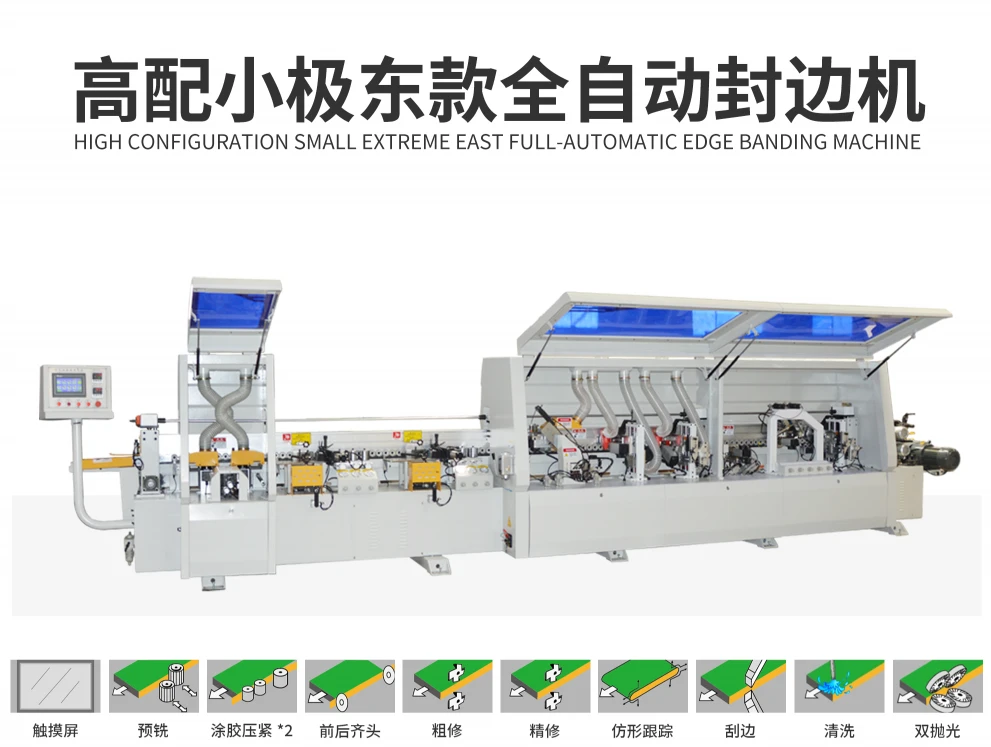
Situated at the forefront of the automatic edge bander, the pre - milling device plays a crucial role in preparing the panel edges for edge - banding. During the manufacturing of panels, their edges may be marred by uneven surfaces, burrs, or small imperfections. The pre - milling device, equipped with high - speed rotating milling cutters, is designed to precisely remove these irregularities. By achieving a smooth and even edge surface, it offers two significant advantages. Firstly, it creates an ideal substrate for the subsequent application of the edge - banding strip, ensuring a secure and tight bond. Secondly, it significantly improves the overall quality of the edge - banding, preventing issues such as bubbling, peeling, or inconsistent adhesion that could otherwise arise due to uneven edges.
3. Gluing System
The gluing system lies at the heart of the automatic edge bander's functionality. Its primary function is to uniformly apply hot - melt adhesive to the edges of the panels. This system typically includes a glue tank, a heating element, and one or more gluing rollers. The glue tank stores the hot - melt adhesive, which is heated to its optimal working temperature by the heating element. Maintaining the correct temperature is vital as it ensures the adhesive remains in a fluid state, allowing for smooth and consistent application. The gluing rollers then transfer the adhesive onto the panel edges. The thickness and uniformity of the glue layer are critical factors in determining the quality of the edge - banding. An insufficient amount of glue may result in weak bonding and potential delamination, while an excessive amount can cause glue overflow, which not only affects the appearance but may also create difficulties during subsequent processing steps. Advanced automatic edge banders are equipped with sophisticated control systems that can precisely regulate the amount of glue applied based on variables such as panel material, thickness, and the type of edge - banding strip being used.
4. Edge - banding Mechanism
The edge - banding mechanism is tasked with the precise placement and attachment of the edge - banding strip to the glued panel edges. Edge - banding strips are available in a variety of materials, including PVC, ABS, and solid wood veneer, each with its own unique characteristics. The edge - banding mechanism is engineered to accommodate these different materials. Once the panel has passed through the gluing system, the edge - banding strip is brought into contact with the glued edge under the controlled action of the edge - banding mechanism. A specialized pressure - applying device within the mechanism exerts the appropriate amount of pressure to ensure a strong and uniform bond between the edge - banding strip and the panel. Additionally, the mechanism may also perform an initial compaction step to eliminate any air gaps between the two, further enhancing the integrity of the bond and contributing to the overall aesthetic appeal of the finished product.
5. Trimming Device
The trimming device is an essential component that follows the edge - banding process. Its main function is to trim off the excess edge - banding material that extends beyond the panel edges. This is crucial for achieving a clean and professional finish. The trimming device typically consists of sharp cutting blades that are precisely aligned to trim the edge - banding strip flush with the panel. There are two main types of trimming operations: end trimming and side trimming. End trimming is used to trim the edges of the edge - banding strip at the ends of the panel, while side trimming is employed to remove any excess material along the sides of the panel. The accuracy of the trimming device is of utmost importance, as even a slight deviation can result in an uneven or unappealing finish.
6. Scraping and Buffing Units
After the trimming process, the scraping unit comes into play. Its function is to remove any remaining glue residue or small imperfections on the edge - banded surface. The scraping unit uses a sharp, angled blade to gently scrape the surface, leaving it clean and smooth. This is followed by the buffing unit, which further polishes the edge - banded surface. The buffing unit is usually equipped with a soft, rotating brush or a polishing pad that is driven at a high speed. By buffing the surface, it not only enhances the aesthetic appearance but also helps to improve the durability of the edge - banding by creating a smooth and sealed surface.
7. Cleaning and Dust Extraction System
Throughout the edge - banding process, a significant amount of dust and debris is generated. The cleaning and dust extraction system is responsible for removing this waste material. This system typically includes suction nozzles placed at strategic points along the machine, such as near the pre - milling device, the trimming device, and the buffing unit. The suction nozzles draw in the dust and debris, which are then transported through a network of ducts to a dust collection unit. Maintaining a clean working environment is not only important for the proper functioning of the machine but also for the health and safety of the operators. Additionally, removing dust and debris prevents them from interfering with the edge - banding process, ensuring consistent quality results.
In conclusion, an automatic edge bander is a complex and highly engineered piece of equipment, with each component playing a vital role in the overall edge - banding process. From the initial feeding of the panels to the final cleaning and polishing of the edge - banded product, the seamless interaction of these components is what enables the production of high - quality, aesthetically pleasing edge - banded panels.